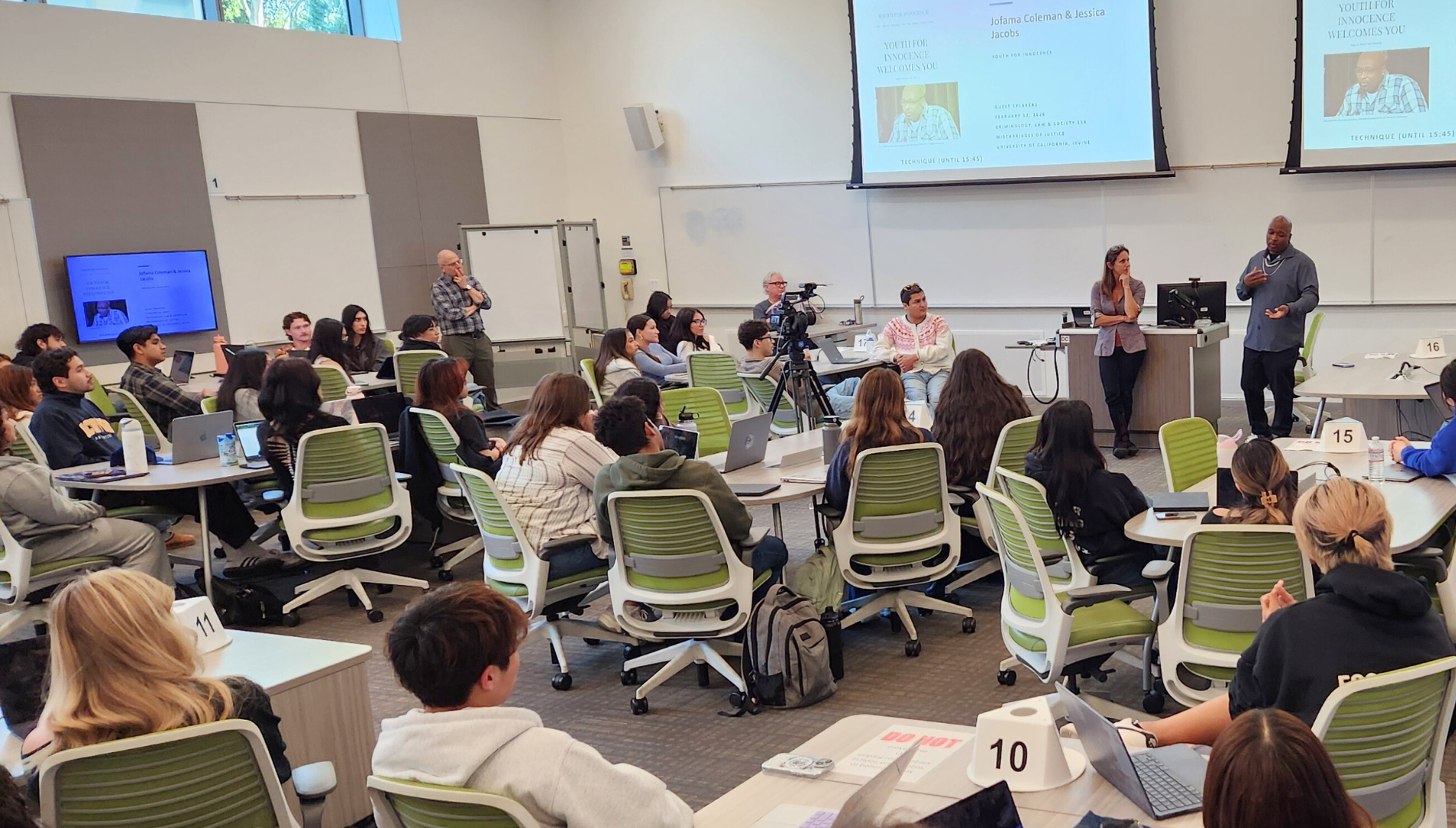
Pair who fought the law and won illuminate Simon Cole’s “Miscarriages of Justice” class
Criminology, law & society Professor Simon Cole recently introduced his UC Irvine “Miscarriages of Justice” class to what he described as “a voice for resilience, justice and second chances” — Jofama Coleman and his tireless advocate, Jessica Jacobs.
Coleman was wrongfully convicted of first-degree murder in Los Angeles and sentenced in 2007 to 72 years and eight months in prison. His journey to freedom culminated in February 2024 with the dismissal of all charges and a finding of factual innocence. Cole, who serves as the editor of the National Registry of Exonerations (NRE), met the pair when he was a guest speaker for Youth for Innocence, a nonprofit dedicated to overturning wrongful convictions.
The partnership between Coleman and Jacobs is as remarkable as it was unlikely. Coleman was a young man from South Central Los Angeles serving what was essentially a life sentence; Jacobs was a mother from Topanga serving lessons to her homeschooled children. Their lives intersected because of a Netflix binge-watch during the pandemic. Jacobs devoured The Innocence Files, and an episode about Franky Carrillo—wrongfully convicted at age 16—ignited something within her.
“There was one scene where this pro bono attorney, a retired public defender who helped Franky get out of prison, said, ‘There’s nothing better a lawyer can do with their license than get an innocent person out of prison.’ And she slammed her hand on the desk in front of her, and she got a tear in her eye,” Jacobs recalled for Cole’s class. “I just got goosebumps.”
This led Jacobs to contact the attorney, Ellen Eggers, and offer assistance. Because the Netflix series had triggered a flood of requests for help from incarcerated people, Eggers gave Jacobs a stack of unsolicited files to sift through. An educator and founder of the alternative secondary school Ditch School, Jacobs turned examining the files into a project for her students. Coleman’s case immediately caught their attention.
In a twist of fate, Coleman’s ex-wife had watched the same Netflix episode and encouraged him to send his file to Eggers. When Jacobs finally called him, he was ready.
“We started talking,” Jacobs says, “and I was like, ‘I’m going to help you get out, but I have no idea what I’m doing.’ That’s when he said, ‘Don’t worry, I’ve been studying law for the last 15 years. I’ll tell you what to do.’”
Coleman explained to Cole's students that while he had educated himself in the law, his status as a prisoner meant he wasn’t taken seriously by the courts. “It’s not until you have professionals involved that people really start to listen,” he said. He described Jacobs as a “bulldozer” who is "pretty damn sharp — super sharp... having her onboard opened the door for me to get things done.”
Despite his exoneration, the weight of nearly two decades lost remains heavy. Coleman spoke of his 21-year-old daughter: “Her age represents damn near the entire length of time in which I was incarcerated. ... I have my freedom, but I don’t have the life that I should have had all this time.”
He concluded by challenging the students—the future prosecutors, judges, and officers—to maintain their integrity. “The key to avoiding these types of miscarriages of justice is basically doing the right thing behind closed doors when no one is looking, right? ... When you guys are working in your careers and get into that arena, just try to be open-minded to the possibility that somebody else probably got it wrong.”
— Matt Coker
Features