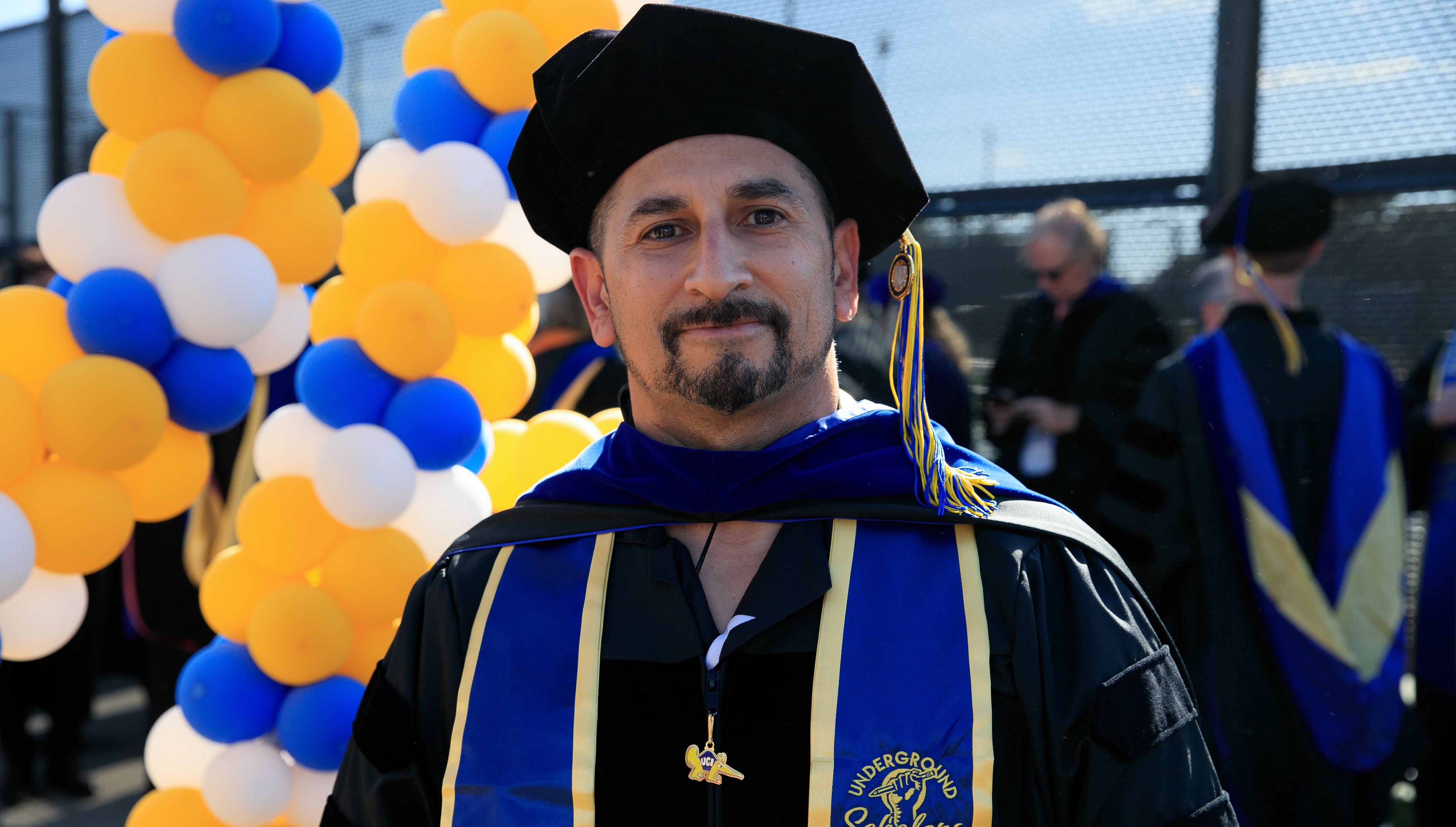
For Gabe Rosales, commencement was more than a milestone. It was the culmination of years of recovery, resilience and refusing to let his past define his future. Inset photos show Rosales with Jennifer Lopez, teaching music in prison and a group shot with his students.
Once a touring musician, Gabe Rosales turns life around to help others
The yard at Richard J. Donovan Correctional Facility where Gabe J. Rosales teaches a rehabilitative songwriting class is a long way from the private planes and sold-out arenas of his past life as a touring musician, but it’s exactly where he wants to be.
Rosales crossed a very different kind of stage today, receiving his doctorate in criminology, law and society from UC Irvine — the same university where, just a few years ago, he was an undergraduate unsure of his direction, carrying the weight of a criminal record and a hard-won sobriety.
His journey is, by any measure, extraordinary. But ask Rosales about it, and he will quickly redirect the conversation.
“I’m one piece in the mosaic,” he says with characteristic modesty. “The educators, the community activists, the musicians in my life — they all make everything I do possible.”
Childhood on the Margins
Rosales, 47, grew up straddling two worlds. His father was a first-generation Mexican immigrant; his mother held advanced academic ambitions of her own, eventually earning a master's degree at UC Santa Cruz.
His parents divorced when he was 8 and he bounced between households. By 14, the friction between him and his mother reached a breaking point and she sent him off to live with his father.
“We were butting heads constantly,” he recalls. “She felt like she couldn't handle me anymore.”
He went to live with his father in a Laguna Beach trailer park. It was, as he puts it, “next to the beach, so it was pretty nice.”
But the glamour was illusory.
His father struggled with alcoholism, was at times mentally and physically abusive toward his stepmother, and the household cast a long shadow over Rosales’ formative years.
By his own account, he had a relatively stable roof over his head — a privilege, he is careful to note, that many of the young men he now mentors never had. But, the gravitational pull of drugs and alcohol found him anyway.
Shredding with Lynch Mob and JLo
Before any of that darkness fully descended, music came first. Barely a year out of high school, Rosales, a bass and guitar player of serious skill, landed a spot on the road with Lynch Mob, the metal band fronted by guitar virtuoso George Lynch. National tours followed. Then, international ones. The gigs grew bigger.
 He found himself on stage with Jennifer Lopez, then Christina Milian, crisscrossing the globe for three years aboard private planes, playing to arenas of thousands.
“I was touring Europe in a private plane,” he remembers. “And five years later, I was cleaning toilets in jail.” He pauses. “Those are kind of big extremes.”
As the profile of his gigs rose, so did his substance use.
In 2004, he was arrested for driving under the influence. He blew three times the legal limit. Then, in 2007, came the charges that would change everything: two offenses that could be tried as either misdemeanors or felonies, related to an aggravated assault with a deadly weapon charge, the product, he says plainly, of a drunken rage.
“It was just typical for me,” he says. “I’d get mad. And I was not proud of that. I didn’t want to be that person anymore.”
Because he had resources, a family who could help him afford quality legal representation, his sentence was reduced from what could have been years to months in Orange County’s Theo Lacy Facility.
He is acutely aware of what that distinction means.
“I’ve taught guys in prison who had the same charges as me, and they got years,” he says quietly. “That’s something I think about a lot.”
The Turning Point
Inside Theo Lacy, Rosales encountered a world that would shape the entire arc of his future scholarship. He watched racial divisions calcify into gang allegiances, privileges dispensed along color lines, a sea of faces — overwhelmingly Black and Latino — cycling through a system that seemed designed to hold them.
His doctors, meanwhile, had delivered their own sobering verdict: at roughly 27 years old, he had the liver of a 70-year-old man. His blood pressure was dangerously high. He was 207 pounds on a 5-foot-6-inch frame.
But it was not his own health that finally broke through.
“You get to a point where it isn’t about you destroying yourself,” he says. “It was the idea that I could hurt people I cared about. That’s when I said, okay, I can’t keep doing this.”
Jail, Rosales says, was where he finally got sober — and where something deeper began to stir.
“I saw how my people were being treated,” he says. “I saw how many were involved in the criminal justice system and what they were up against.”
For the first time, he began to wonder whether music, and his life, could be pointed at something larger.
From Saddleback to Grad School
By 2010, Rosales was enrolled at Saddleback College in Orange County, taking a partial load while teaching private music lessons and gigging on weekends — habits he has maintained for more than two decades.
He flirted with anthropology — fascinated, he admits, until he looked at the employment statistics.
“Anthropology job transfer rate: 8%. Criminology: 100%,” he deadpans. “Plus, I just fit right in. Having spent time in jail and being in recovery, it was perfect.”
By 2015, he had transferred to UC Irvine.
In 2017, he graduated with a bachelor’s degree in criminology, law and society. He then applied to the university’s doctoral program, with an eye toward the joint J.D.-Ph.D. pathway — but did not gain admission.
So, he pivoted, took the LSAT, and enrolled at Western State College of Law, where tuition assistance covered nearly his entire program. It seemed like a promising detour.
Then, he started teaching in prison.
In 2018, Rosales began leading classes at the Donovan Correctional Facility in San Diego through a nonprofit program called Jail Guitar Doors — a name that carries a kind of poetic double meaning.
The organization, which has roots in the United Kingdom, dating to the early 2000s (guitarist Billy Bragg partnered with it in 2009 to launch the U.S. program), provides acoustic guitars — donated at cost by Fender — and journals to incarcerated students for a 10-week curriculum unlike any other.

Chords Meet Confession
The program is built around weekly themes: childhood, family, restoration, forgiveness, anger, resentment. Students are given guitars and journals, and they write. The writing is not assessed for literary merit. It is not corrected for grammar.
It is, Rosales says, an act of raw truth-telling: “The honesty is what matters. It doesn’t matter if you aren’t the most skilled writer, musician, or anything. You have to mean it.”
At the end of each session, two lines are pulled from each student’s journal. The class then writes a song — a communal composition built entirely from what the students have poured onto the page. Twenty men who, minutes earlier, would not have looked each other in the eye, are sitting together, singing about their children and their grief.
“It is so moving,” Rosales says, his voice softening. “It’s very emotional to see guys who would never talk to each other on a prison yard, sitting together, telling each other about their family members and their kids. And that translates to the yard, too.”
That translation — the way personal agency and collaboration between populations dissolves walls that institutional programming cannot — is central to his research.
Rosales became fascinated by what the California Department of Corrections and Rehabilitation calls Non-Designated Programming Facilities (NDPF), prisons that deliberately integrate racially segregated populations and people with a variety of criminal records in the name of rehabilitation.
Watching it work — rival gang members sharing a guitar — has, he says, “totally blown my mind.” And, he documents the NDPF’s creation in his dissertation, “Echo Facility — The Going-Home Yard: A Historical Descriptive Analysis of California’s Pilot Prison Facility Through a Lens of Generative Justice,” which also explores three program options on the yard: peer to peer mental health, education (UCI’s LIFTED program), and arts in corrections with Jail Guitar Doors.

Building Underground Scholars
The same year he began teaching at Donovan, Rosales also withdrew from law school and reapplied to UC Irvine’s doctoral program. This time, he was admitted.
He also threw himself into building out UCI’s chapter of Underground Scholars, an organization he had helped plant the seeds for even before his undergraduate graduation in 2017, when discussions about founding a UCI chapter were already underway.
By 2018, it was official — a peer-led hub on campus built around three pillars: outreach, retention and advocacy.
The outreach means reaching into community colleges and, increasingly, into correctional facilities themselves to find prospective transfer students and introduce them to the possibility of a UC education. The retention means making sure they stay: providing a community of peers who understand what imposter syndrome feels like when you are a formerly incarcerated student walking onto a UC campus for the first time, unsure whether you belong there.
“There’s a long history of this kind of work in the California system,” Rosales notes. Project Rebound, founded more than 50 years ago at San Francisco State, blazed the trail, but Underground Scholars brought that model to the UC level.
The advocacy means showing up at the State Capitol. It means fighting for policies like Proposition 57, which created Rehabilitative Achievement Credits (RAC) — the framework under which Rosales’ Jail Guitar Doors classes are officially accredited, offering students up to 12 days off their sentence for every 52 hours of coursework.
It means pushing for “ban the box” policies that remove the requirement to disclose criminal history on college applications, a reform Rosales felt personally when he reapplied to UCI’s doctoral program and, for the first time, was not asked about his record.
“Things are evolving,” he says. “Academic institutions are looking at formerly incarcerated people differently. They’re giving us more opportunities and not stigmatizing us as much. But, there’s still a long way to go.”
Keramet Reiter, professor of criminology, law and society and Rosales’ mentor, praised his research and organizing efforts.
“Gabe is one of those rare people who knows everyone, builds meaningful relationships, and uses those networks to do good,” she said. “He co-founded PrisonPandemic, helped launch UCI's LIFTED and his dissertation on the very unit where we work had five faculty members saying, 'Can we come to his dissertation defense? We can’t wait to hear it.' His research is as rooted in the community as his organizing work. When he told me he was graduating, my heart broke a little — but I know he'll keep making an impact.”
Rosales is not the only person whose story he wants to tell. He speaks readily and admiringly of his peers who have overcome obstacles like his own. The stories, Rosales argues, need to be visible.
“If younger people who are caught up in these situations can see people like themselves reaching these levels of success, getting new opportunities, creating a pathway, they’re going to be more apt to take those roads,” he says. “It creates hope. And hope is something the system is not exactly built to provide.”
What’s Next
Rosales has been teaching criminal justice courses at Cal State Fullerton for the past year as a lecturer and intends to pursue a tenure-track position.
“I believe everyone deserves a second chance,” he says. “I believe people can change. All the formerly incarcerated students and scholars around the country are a testimony to that.”
He will also, of course, keep releasing music — because that is not negotiable, and never has been.
“Creating something that did not previously exist is one of our main purposes on this planet,” Rosales says, speaking as an artist and educator with equal conviction. “I’m never going to stop.”
— Mimi Ko Cruz