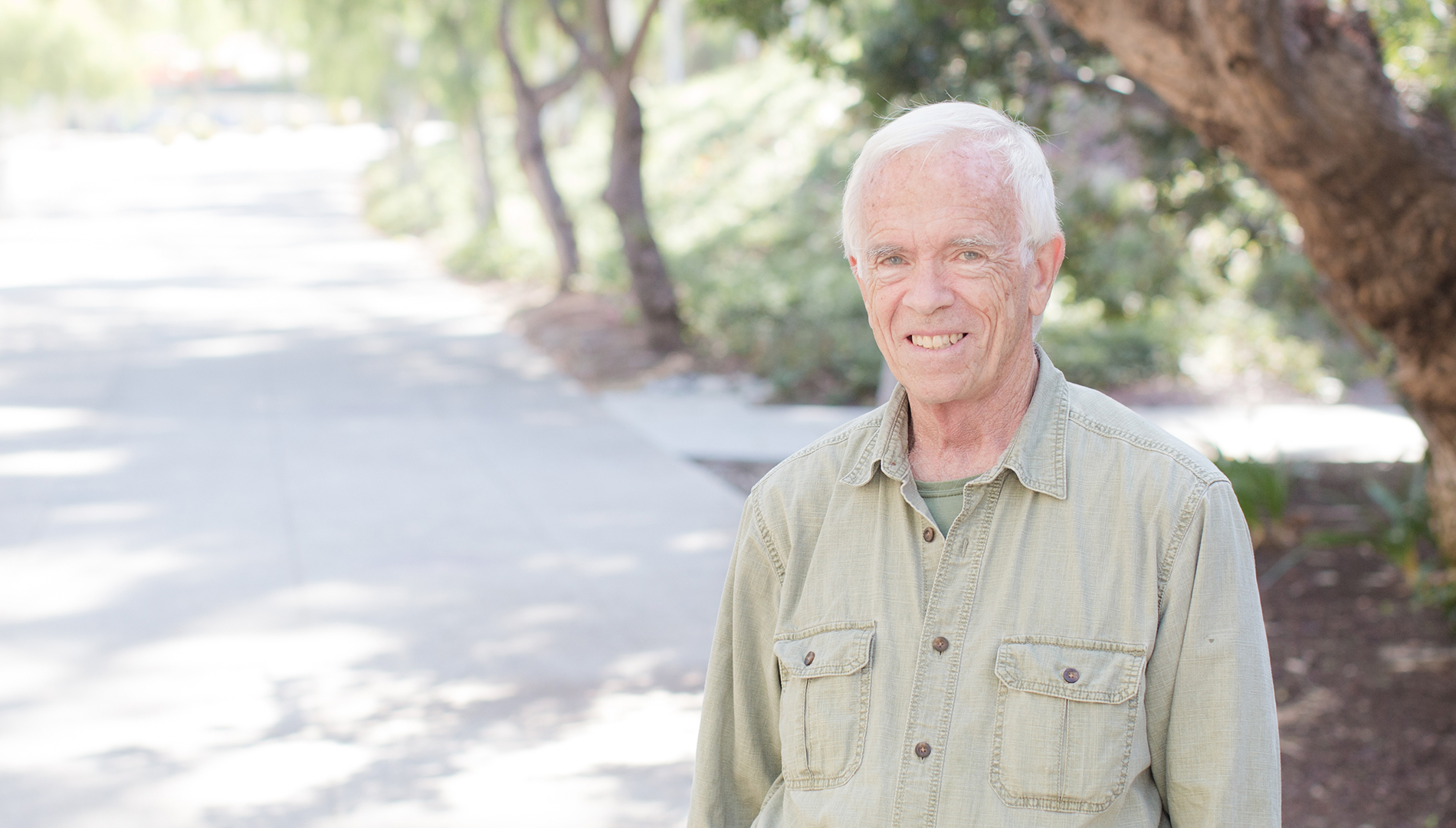
Distinguished Professor Elliott Currie’s lifetime of critical criminology earns top honor
By Matt Coker
If you ask Elliott Currie where he’s headed this November, he’ll tell you he’s going home. Not just to Chicago, the city where he grew up and first wrestled with the questions that would shape his career, but to a gathering of colleagues and students who have become, in his words, “my people.”
The occasion? The UC Irvine Distinguished Professor of criminology, law & society is the recipient of the 2026 American Society of Criminology Division on Critical Criminology & Social Justice Lifetime Achievement Award—the highest honor bestowed by the division.
The ceremony will take place at the Exchequer Restaurant, a storied downtown spot rumored to have been a favorite haunt of Al Capone. “That seems appropriate, or ironic, or something like that,” Currie says with a smile. “But more importantly, I’ll be going back to my own origins and the place where I started thinking about these issues I teach and write about in the first place.”
A career of courage and commitment
The award recognizes more than five decades of Currie’s work, which has fundamentally changed how scholars and the public understand the links between violence, inequality, and social policy. Emily Troshynski, chair of the ASC Division on Critical Criminology & Social Justice, wrote in her letter to Currie, “Your selection reflects the significance of your work and its lasting influence on our field. This award honors a career that has embodied the intellectual courage, commitment to justice, and deep humanity at the heart of critical criminology.”
Currie’s scholarship has never shied away from controversy. In the 1980s, as the U.S. shifted toward a more punitive approach to crime and the country’s prison population exploded, he was one of the most prominent voices challenging the prevailing drift. “What we were doing wasn’t grounded in any of the serious research criminologists worth their salt had been doing for decades,” Currie recalls. Our national crime policies, he argues, “were increasingly based more on ideology than on what we actually knew about crime.”
However much of the serious research was confined to academic journals that few people outside of the discipline ever read. Currie, along with other criminologists who were frustrated by the growing gap between knowledge and policy, became convinced that bringing the best scholarship to a much broader audience was essential. “And this is the kind of writing I’ve been doing ever since,” he says.
“I wasn’t the only one doing it,” Currie says. “I was one voice within a larger movement of scholar-activists that I’m very proud to have been a part of. And I do believe that, collectively, we had some impact on the debates about crime and punishment in America.”
His books—including Confronting Crime: An American Challenge (1985), Crime and Punishment in America (a 1999 Pulitzer Prize finalist), Whitewashing Race (winner of the Benjamin L. Hooks National Book Award), The Roots of Danger, and A Peculiar Indifference: The Neglected Toll of Violence on Black America (a New York Times Notable Book of 2020)—have offered rigorous, humane alternatives to punitive crime control.
As the selection committee noted, “Professor Currie's work is not only about social justice but for it. As a public criminologist, he has taken critical scholarship to policymakers, journalists, and the general public while partnering with communities from Oakland to Kansas City to the United Kingdom and Australia.”
Mentorship and legacy
Currie’s impact extends far beyond his publications. Since joining UCI in 2004, he has cherished his role as a mentor, especially to graduate students. “I have learned so much from my graduate students and have so many fine memories,” he says. “It’s been a tremendous honor to have been able to work with an extraordinary group of emerging scholars who are carrying on this work in their own right. I wouldn’t trade that experience for anything.”
He’s particularly proud that many of his former students have carried forward his commitment to social justice. “They have a sense of mission to take this work out to the real world, and they are doing a great job,” Currie says. The upcoming ceremony will be especially meaningful, as the award will be presented by Troshynski, one of his former UCI graduate students and now a professor at the University of Nevada at Las Vegas.
The work continues
Reflecting on his career, Currie acknowledges that many of the challenges he wrote about decades ago remain stubbornly persistent. “Part of me gets very indignant,” he says wryly, “that the country didn’t rush to adopt the alternative vision of crime and punishment that many of us were advocating. Actually, a lot of things did change, but a lot are still with us. Mass incarceration in America, the way we treat people in prisons and jails, our unusual problem of serious violence—these continue to distinguish us from other advanced nations.”
Yet Currie sees progress, especially in the early 21st century, as the idea of prisons as a panacea for crime began to fade. “We did see a turnabout in prison populations, to some extent. There are still too many people behind bars, but the prison population has shrunk since 2008-09. I think the accumulating criticism of mass incarceration was partially responsible for that. People realized it just wasn’t working and that it had intolerable human consequences.”
The Distinguished Scholar points to the widespread feeling that society had to explore other alternatives, “and here in California and other parts of the country, we did just that.” Currie acknowledges, “The successes were uneven, and sometimes fragile, but they were significant.”
He takes consolation in the fact that, had no one challenged the drift of criminology and justice policies, things might look much more bleak. “Holding the line prevented even worse outcomes.” Currie says. “That’s one of the reasons I plan to keep doing this work—there’s always the threat of more punitive approaches to people who break the law, and even those who don’t.”
A homecoming and a celebration
For Currie, the award is not just a recognition of past achievements but a call to continue the work. “It’s a reminder that the issues we’ve been trying to confront aren’t going away anytime soon,” he says, adding that he is very much looking forward to the award ceremony.
“It’s an honor,” he says. “I’m really excited to be there and to spend time with good friends I’ve been working with for years. Chicago is my hometown. I wouldn’t miss it.”
As he returns to the city where his journey began, his story reminds us that critical criminology is not only about rigorous scholarship — it’s about courage, engagement, and a relentless pursuit of justice. And for Currie, the work goes on.